MetaBot is the next generation of our suggestion assistant, designed to improve the way you describe your catalog.
It works as a suggestion engine, guiding users in describing objects accurately and ensuring quality.
Why does a catalog need a suggestion engine?
When building a catalog, the focus is often on identifying the various objects to be mastered, such as business terms, indicators, tables and fields. This leads to a comprehensive glossary or dictionary, which is a valuable first step. However, simply listing these elements quickly shows some limitations.
Take the business term "customer name": as a marketing user, you might find this term three times in the glossary. If an object hierarchy exists, it might offer some clarity on these terms. Without a hierarchy, you have to rely on the attributes in each object's card, which can fall short. Questions arise: is the definition correct? How can you tag the objects to make them easier to identify and find? Are there specific compliance constraints for each object?
The challenge is to make object descriptions in the glossary both accessible and reliable. MetaBot addresses this need. The first iteration of MetaBot focuses on three key areas:
- Object tagging, through suggested tags
- Conformity, by helping identify data sensitivity levels
- Collaborative quality of descriptive text, through shared effort and feedback
These features enable more precise descriptions and better object management across your catalog.
What does MetaBot suggest?
MetaBot assists in data curation by providing automatic suggestions to enrich and complete object cards. For example, it offers:
- Tag suggestions: MetaBot recommends tags, both standard and custom, that improve categorization and searchability.
- "Personally Identifiable Information" (PII) suggestions: it suggests appropriate classifications for personal data, helping ensure accurate and compliant data management.
These features make it easier to fill in and maintain the necessary attributes for each object, streamlining data organization and quality.
How are suggestions generated?
MetaBot analyzes the object's technical label, description, summary, tags and keywords to give you a list of suggested tags and PII values that may match the object. It also analyzes whether suggestions are accepted or rejected, in order to offer new suggestions adapted to your object.
Check your screen settings
To see MetaBot's suggestions, first check that the attributes you created appear in the screens. You may have attributes created in your administration area that are not yet in the screen configuration. In that case, the suggestions cannot be visible.
To learn more about screen customization, see "[How to] Customization of client space screens" and "[How to] Customize the Workspace screens" in the Administer section.
To learn more about MetaBot's suggestions, see Data classification via MetaBot.
What is the evaluation score?
MetaBot offers an evaluation score indicator that lets you estimate the quality of the text entered in rich text attributes (for example Description). It also offers a voting system to evaluate the text entered. After the votes, the system recalculates the evaluation score. This indicator helps you identify the level of confidence in the quality of certain texts, such as descriptions.
Vote on a text
Once the text is filled in, all users who have access to the object can vote "Like" or "Dislike" to evaluate the semantic quality of the attribute. You can also cancel or change your vote. If the text is updated, MetaBot takes the change into account to re-evaluate the score associated with the text, alerts you that your vote is obsolete, and invites you to vote again.
How is the evaluation score calculated?
When you enter text in a rich text attribute, MetaBot analyzes the text and gives you an evaluation score. The score appears in a small widget next to your attribute. If you update your text, MetaBot recalculates a new score. If users vote on the text, MetaBot also analyzes this data to adapt the score.
Where can you see the suggestions?
To see the suggestions and the evaluation score proposed by MetaBot, go to Suggestions in the navigation panel.
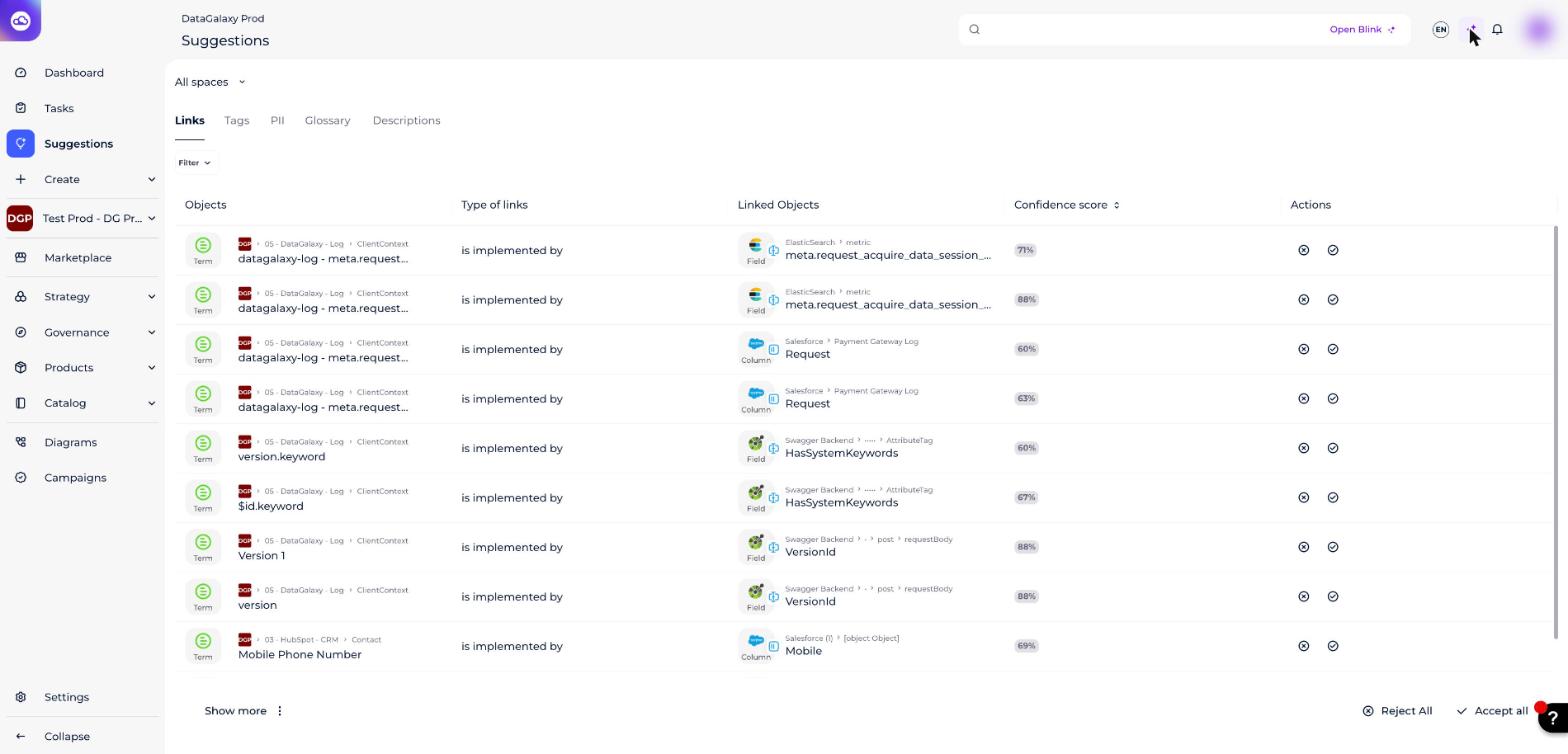
The Suggestions page has one tab per suggestion type: Links, Tags, PII, Glossary and Descriptions. MetaBot's information is also visible from the object card.
When should you use MetaBot?
The aim of this evolution is to improve the functional quality of your glossary and dictionary by relying on collaboration. It helps you in particular:
- When you need to harmonize and reconcile definitions: you have several formulas for an indicator or several descriptions for a business term and you want to refine them and gradually bring them closer together.
- When you want help tagging catalog objects to make them easier to identify and search.
- When you want to provide a first level of GDPR compliance by identifying the sensitive data you manage.