Multilingual AI supports seven languages. Client space administrators choose which of them your data catalog is translated into, and can follow the progress of each translation.
What languages does the Multilingual AI feature support?
DataGalaxy's Multilingual AI feature supports the following languages:
- French
- English
- German
- Italian
- Spanish
- Dutch
- Portuguese
You can submit a request to add a new language from our Freshdesk support portal.
How many languages can my data catalog be translated into?
There is no limit to the number of languages. You can translate the catalog into any language supported by the multilingual feature.
How do I add a new language to my data catalog?
Only client space administrators can add a new language to the Multilingual feature. To add a new language:
- Go to the languages tab in the Multilingual section of the administration panel.
- Click on the
+button on the right of the screen.
- Choose a target language from the list of available languages. If the language of your choice does not appear in the list, you can submit a request to add a new language from our Freshdesk support portal.
- Click on the Add button.
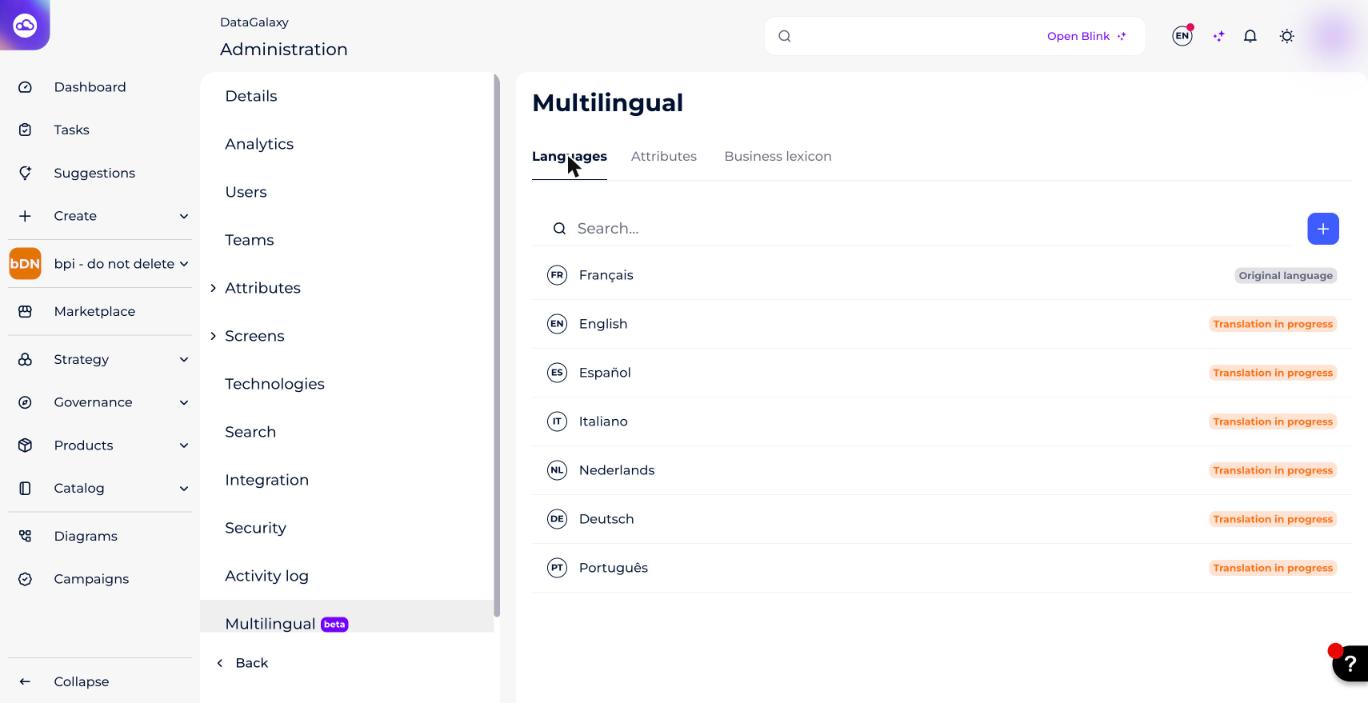
The Languages tab lists each language with its status: Original language for the source language, and Translation in progress while translations are being generated.
How long does it take to generate translations when adding a language?
This depends on the number of objects in your catalog and the number of attributes to be translated. It can take up to 48 hours. Once it's finished, a notification is sent to all users to let them know that the data catalog is now available in a new language.
How do I know if translations are in progress?
A red dot appears on the language menu, meaning that translations are in progress. When you open the menu, an attention icon shows which languages are currently being translated.
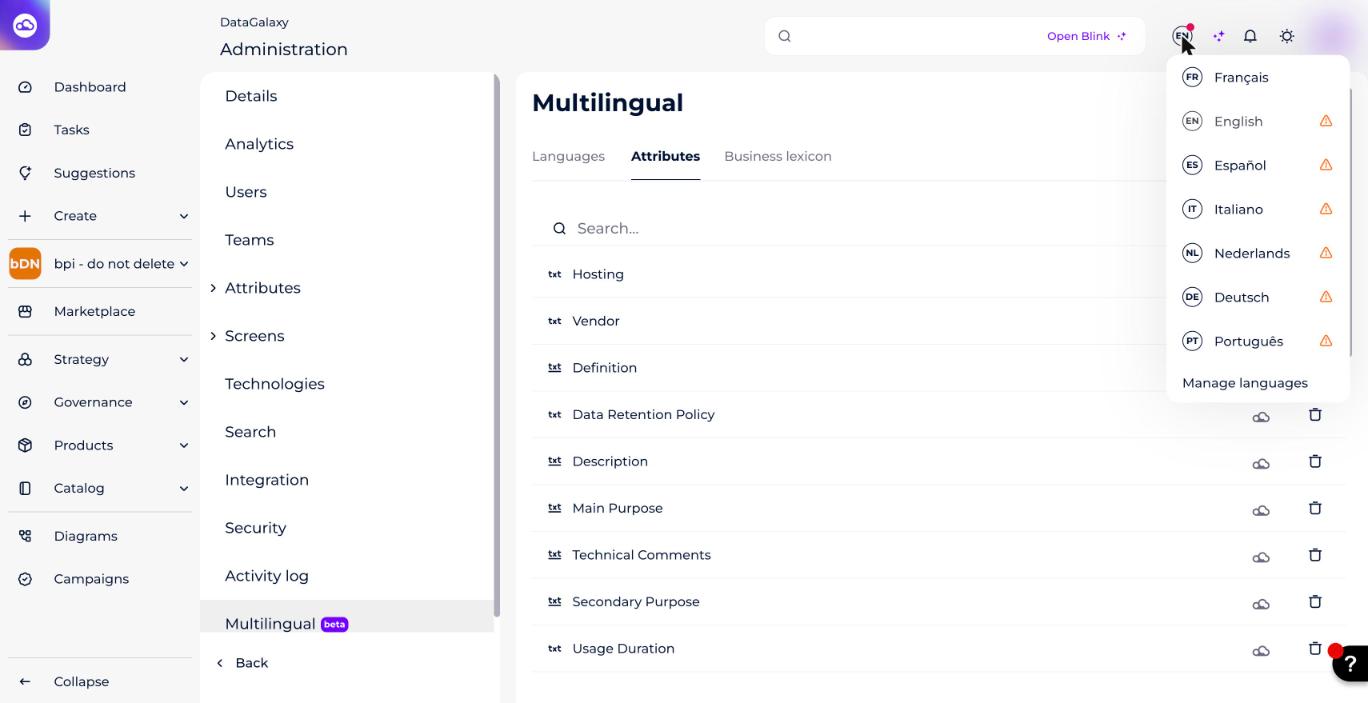
The language menu also has a Manage languages link that opens the Multilingual page.
As a client space administrator, you can monitor the progress of translations from the Multilingual language management page.
In which languages can individual objects be created?
Objects can be created from the platform in any of the multilingual languages supported by the Multilingual AI feature. The object is instantly translated into all the other languages.
In which languages can objects be imported?
Objects are automatically imported into the data catalog's original language, whether via:
- CSV import
- Connectors
- API
Translations become visible after a few hours of processing. Translation times vary according to the number of objects to translate.
Are the interface languages the same as the Multilingual AI languages?
When the Multilingual AI feature is activated, the available interface languages (which you can change from your user profile) are synchronized with the multilingual languages. As a result, an interface language may no longer be available after multilingual activation if the catalog has not been translated into that language. If a user is in a language that is not part of the Multilingual AI system, they are switched to the original language when the multilingual system is activated.
What if my data catalog is filled in several languages before the Multilingual AI feature is activated?
The Multilingual feature supports only one source language. We recommend that you indicate the predominant language of your data catalog as the original language, and set your second original language as the target language.
This way, content in the original language you specify is translated into the target language. Content that is already in the target language remains in the target language: the original language is not translated, and in the target language the model detects that the text is already in the right language, so it doesn't translate it.