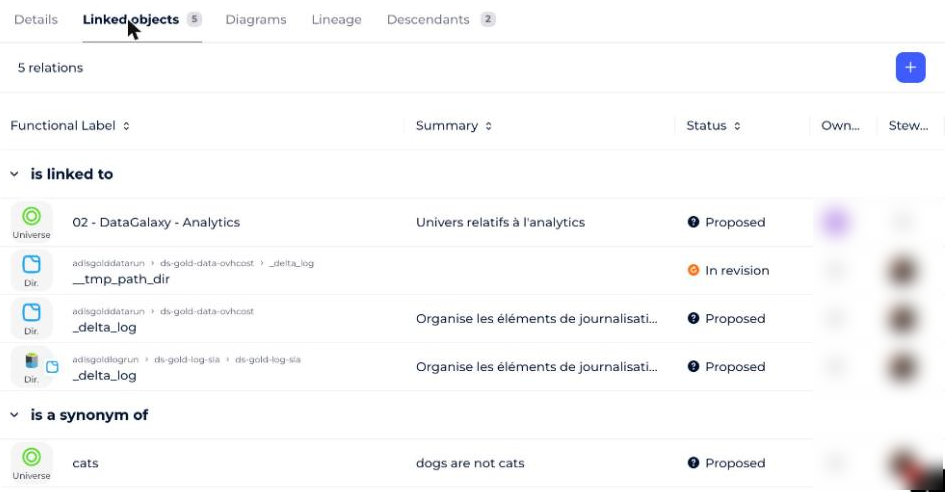
The purpose of relationships is to create, modify and delete relationships between objects in the glossary. The aim is to be able to materialize any type of relationship (link, semantics, calculation...) between data.
This function lets you track and document the simple or complex relationships that exist between data, to structure understanding and share knowledge.
What is a relationship?
- The relationship exists between two distinct objects in the glossary.
- The relationship is valid between one or more types of data in the glossary.
- A relationship belongs to a category of relationships: semantics, taxonomy, calculation, etc.
- A relationship can be mono- or bi-directional. In the latter case there is a master direction, which defines the relationship between the current object and the object to select, and a corollary direction, which defines the relationship between the selected object and the current object.
Which relationships can each object have?
The original article presents these relationships as a matrix: master objects in rows, subordinate objects in columns (Domain, Universe, Concept, Business term, Indicator, Nomenclature, Dimension, Dimension group, Indicator group, Value). For each master object, the relationships it can have are listed below.
The matrix lost its column layout when migrated, so which subordinate object each relationship points to isn't shown here. Rebuild it as a table from the product or the original article before publishing.
- Domain: is the domain of (for each of the other object types)
- Universe: has for domain; is the universe of
- Concept: has for domain; is a synonym of; generalizes; specializes; depends on; is needed by; is part of the dimension
- Business term: has for domain; is a synonym of; generalizes; specializes; is used for computation of; has for reference data; is part of the dimension
- Indicator: has for domain; is computed by; is a synonym of; generalizes; specializes; is used for computation of; is declined according to the dimension
- Nomenclature: has for domain; lists values for
- Dimension: has for domain; has for universe; regroups; declines; is a synonym of; generalizes; specializes
- Dimension group: has for domain; has for universe
- Indicator group: has for domain
- Value: has for domain; transcodes
How to import relationships
- Go to the Glossary.
- Open the menu with the 3 dots and click Import.
- Drop your file in the dedicated section.
- Click Start import.
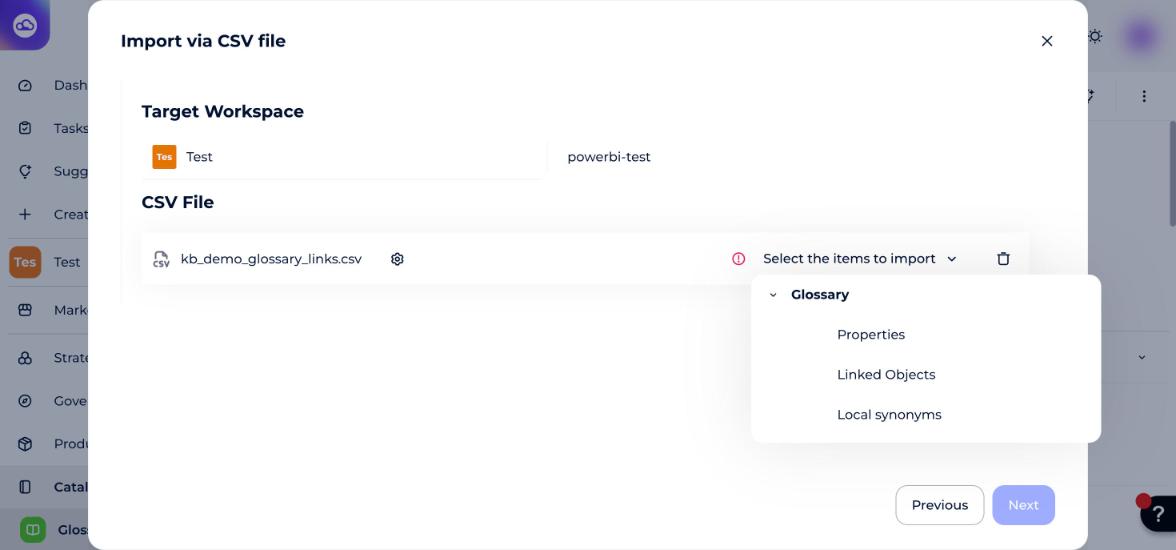
- Choose Linked objects as the items to import.
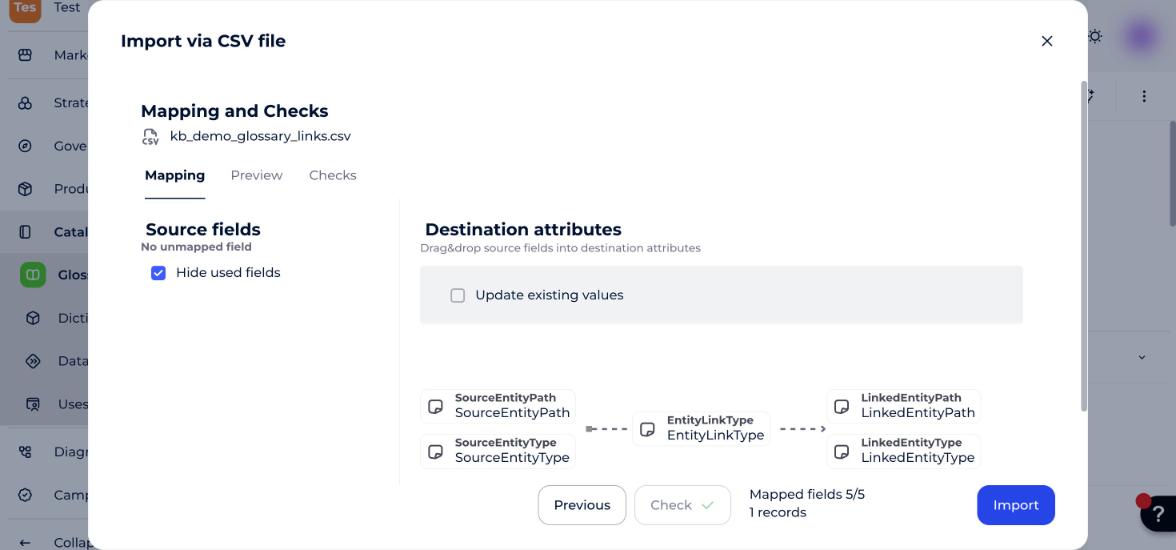
- Check the accuracy of the fields.
- Click the Import button to start the import.
How to delete a relationship
You can delete a relationship between several objects:
- Click the object for which you want to delete the relationship.
- Click the Linked objects tab. The existing relationships are displayed in a table.
- Click the delete icon to remove the relationship.